

Quadruple Witching Ahead: Should You Hold Your Positions or Sit on the Sidelines?
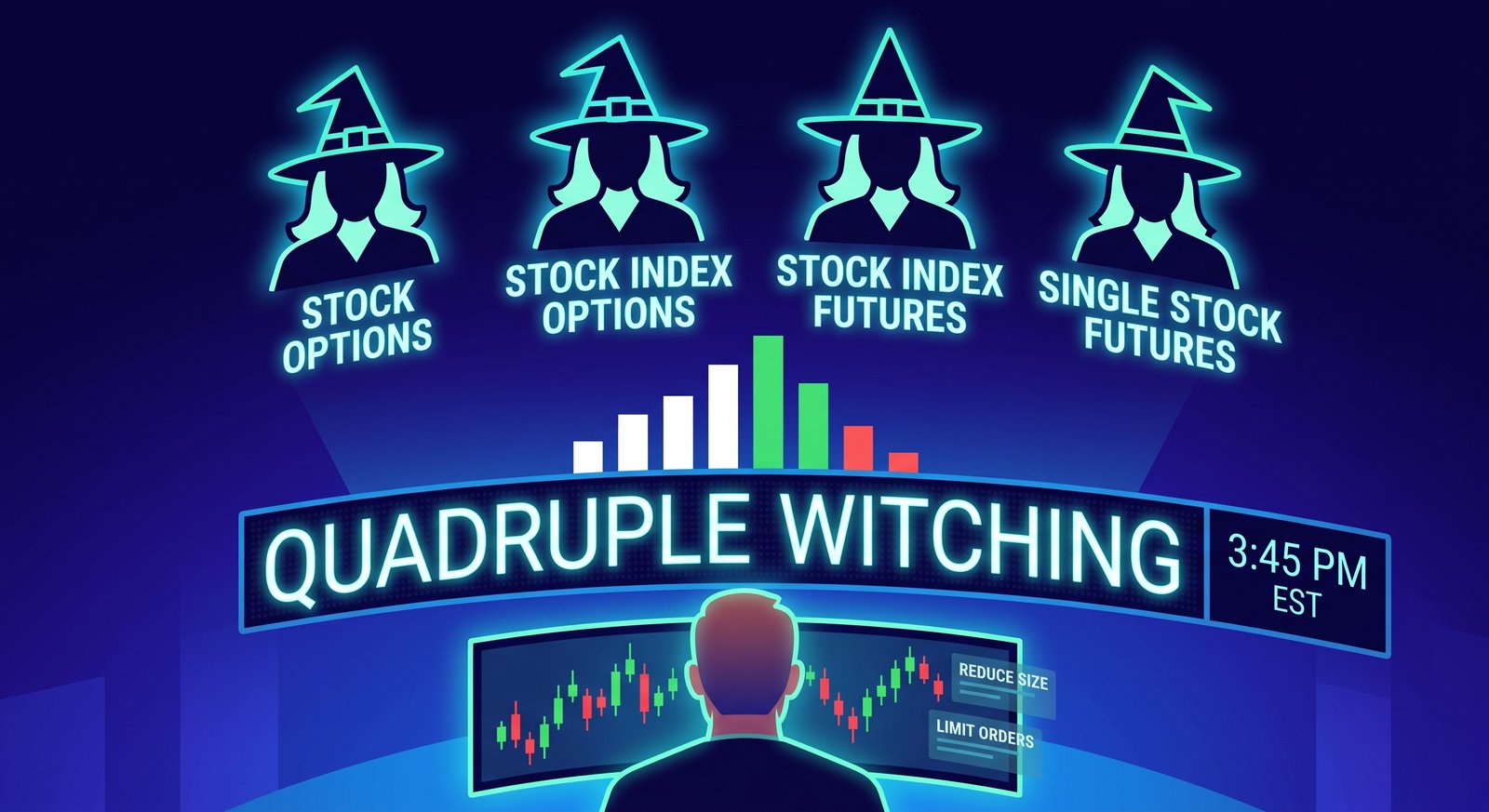
Every quarter, a unique mechanical storm rolls through Wall Street: Quadruple Witching. Occurring on the third Friday of March, June, September, and December, this trading day sees billions of dollars in options and futures contracts expire simultaneously.
With massive institutional rebalancing, algorithmic unwinding, and record volume expected tomorrow, retail traders are facing critical questions: Should I close my open positions today? Should I trade tomorrow or stay on the sidelines?
Here is a complete breakdown of what actually happens on Quad Witching, how it affects individual traders, and a strategic framework to protect your portfolio.
What Is Quadruple Witching?
Quadruple Witching refers to the simultaneous expiration of four major derivative contracts:
- Stock Options: Contracts tied to individual single equities (e.g., Apple, Nvidia).
- Stock Index Options: Options tied to broad market indexes like the S&P 500 (SPY) and Nasdaq 100 (QQQ).
- Stock Index Futures: Futures contracts on major market benchmarks (e.g., E-mini S&P futures).
- Single Stock Futures: Futures on individual equities (Note: U.S. markets officially migrated to Triple Witching when single-stock futures stopped trading in 2020, though traders still use the legacy name).
💡 The "Witching Hour" Effect:
The most intense activity occurs during the final 60 minutes of the trading day (3:00 PM – 4:00 PM EST). Institutional fund managers and market makers scramble to rebalance multi-billion-dollar positions, producing massive volume surges and unpredictable price spikes.
How Quadruple Witching Helps & Hurts Retail Traders
Trading on expiration day is a double-edged sword. Institutional rebalancing alters market dynamics in ways that create both distinct advantages and dangerous pitfalls.
| How It Helps Retail Traders (Pros) | How It Hurts Retail Traders (Cons) |
| Deep Market Liquidity: Sky-high order flow allows swing and day traders to enter/exit large positions smoothly with lower slippage. | Erratic Algorithmic Whipsaws: Sudden block-trade imbalances trigger sharp price swings that can knock out tight stop-losses before reversing direction. |
| Temporary Mispricings: Forced institutional rebalancing often pushes solid stocks away from fair value, creating fast mean-reversion setups. | Wide Bid-Ask Spreads: High volatility in rapidly moving option chains can temporarily expand bid-ask spreads, impairing trade execution. |
| Inflated Option Premiums: Implied Volatility (IV) often spikes ahead of the open, giving premium sellers favorable entry points. | Extreme IV Crush: Option buyers often suffer rapid premium decay even if the underlying stock moves in their predicted direction. |
Should You Keep Your Current Position?
Your decision to hold or close open positions tonight depends entirely on your trade structure and overall time horizon:
1. Long-Term Investors & Buy-and-Hold Portfolios
- Action: KEEP YOUR POSITION.
- Reasoning: Quadruple Witching is a structural liquidity event, not a fundamental shift in economic reality. Volatility on expiration day rarely alters broad market trends over weeks or months. Ignore the intraday noise and stay the course.
2. Options Expiring Tomorrow (Near At-The-Money)
- Action: CLOSE OR ROLL EARLY.
- Reasoning: Near-dated options face accelerated theta decay (time decay) and severe pinning risk—a phenomenon where market maker hedging anchors underlying stocks near major strike prices into the close. If you want to maintain exposure, roll your contracts into a future expiration month.
3. Short-Term Swing & Day Trades
- Action: ADJUST STOP-LOSSES & SIZING.
- Reasoning: High volume increases intraday noise. If keeping open equity swing positions overnight, widen your stop-losses slightly to avoid getting caught in algorithmic hunting, or lock in partial profits ahead of the open.
Should You Trade Tomorrow?
⚠️ Key Rule: Volume Does Not Equal Direction
A common trap for retail traders is mistaking high Quad Witching volume for institutional conviction. A massive closing imbalance simply reflects mandatory contract settlement, not a new multi-week bull or bear trend.
When You Should NOT Trade Tomorrow:
- During the Final 30–60 Minutes: Avoid opening new directional positions during the closing cross (3:00 PM – 4:00 PM EST) when order imbalances create chaotic price spikes.
- If Your Strategy Relies on Tight Stops: Breakout setups frequently fail on Quad Witching due to sudden algorithmic reversals.
When You CAN Trade Tomorrow:
- If You Play Mean-Reversion Setups: When heavy institutional flows temporarily push an equity off its intraday value area, disciplined traders can capture short-term rebounds.
- If You Specialize in High-Volume Scalping: Active traders who thrive on high liquidity and fast execution will find plenty of market movement.
4 Actionable Rules for Quad Witching
1. Reduce Position Size: Cut standard position sizes by 25% to 50% to accommodate higher volatility without risking excessive capital.
2. Use Limit Orders Exclusively: Avoid market orders, especially during market open and close, to prevent getting filled at bad prices inside widened spreads.
3. Audit Your Option Chains: Verify that no short option positions are sitting vulnerable to unwanted assignment over the weekend.
4. When in Doubt, Cash is a Valid Position: Stepping aside and waiting for Monday’s clean slate is often the smartest move for risk-averse traders.
Disclaimer: This article is strictly educational and does not constitute financial or investment advice. Always manage your own risk and consult a certified financial advisor before making trading decisions.